Friday, July 9, 2010

Wednesday, July 8, 2009
Back in the U. S. of A.
 "The whole object of travel is not to set foot on foreign land;it is at last to set foot on one's own country as a foreign land."- G. K. Chesterton
"Sailing round the world in a dirty gondola oh, to be back in the land of Coca-Cola!"- Bob Dylan
"It is far easier to travel than to write about it."- David Livingstone
Once again I am back in the USA; a two-month sojourn among family, friends and familiar places. Since I have been unable to access Blogspot, this entry will be an arbitrary recap, primarily through pictures, of my recent months in Yiwu, China.
I have enjoyed my teaching situation at the college, both the schedule and the students. My work week consisted of ten teaching hours spread out over 6 classes. Not too strenuous. Since I am teaching oral English, I have had the opportunity to select a variety of topics for the students to expound upon: What is more important, freedom or security? How do you think the rest of the world views China? How has China changed in the last 50 years? What is the ideal life? Etc… Typically I only comment on their grammar and pronunciation, but it allows me a unique and fascinating view into the student’s values and perspectives.
When I am not working, my time is spent at home, socializing or wandering the streets. At home I am usually on the computer; emailing, watching movies or surfing the web. My social outings are usually with other teachers or students, and each interaction subtly deepens my understanding of the culture and people. When I aimlessly wander, there is a constant barrage of sights, sounds and aromas. Maybe there are in the West as well, but prolonged exposure has relegated them to a less conscious awareness on my part. Whereas here, people working, children playing, vendors, shops…. All possess an arresting quality.
Yiwu is the largest small commodity city in the world, and the business of buying and selling is evidenced everywhere. The actual commodity market itself is made up of about 60,000 small shops selling everything imaginable.
I have had the chance to take a few short trips. The first was when one of my classes asked me to join them on a school-sponsored camping trip. It turns out that ‘camping’ is a relative term. Expecting tents and a campfire, I found myself on an outward-bound type of adventure, Dressed in army fatigues, we crossed rope bridges, scaled climbing walls, and navigated through a variety of obstacles and challenges.
I spent a few days in Huang Shan (Yellow Mountain). These are the craggy peaks one often sees depicted on the walls of Chinese restaurants. Instead of an earthen trail, steps are carved into stone. There are hotels to stay at on top of the mountain, and their supplies are carried in by porters. Tough job.
I also spent a couple of days in Hangzhou with some of my students, and have had a variety of day trips with students or other teachers.
Enjoy the pictures!
I have enjoyed my teaching situation at the college, both the schedule and the students. My work week consisted of ten teaching hours spread out over 6 classes. Not too strenuous. Since I am teaching oral English, I have had the opportunity to select a variety of topics for the students to expound upon: What is more important, freedom or security? How do you think the rest of the world views China? How has China changed in the last 50 years? What is the ideal life? Etc… Typically I only comment on their grammar and pronunciation, but it allows me a unique and fascinating view into the student’s values and perspectives.
When I am not working, my time is spent at home, socializing or wandering the streets. At home I am usually on the computer; emailing, watching movies or surfing the web. My social outings are usually with other teachers or students, and each interaction subtly deepens my understanding of the culture and people. When I aimlessly wander, there is a constant barrage of sights, sounds and aromas. Maybe there are in the West as well, but prolonged exposure has relegated them to a less conscious awareness on my part. Whereas here, people working, children playing, vendors, shops…. All possess an arresting quality.
Yiwu is the largest small commodity city in the world, and the business of buying and selling is evidenced everywhere. The actual commodity market itself is made up of about 60,000 small shops selling everything imaginable.
I have had the chance to take a few short trips. The first was when one of my classes asked me to join them on a school-sponsored camping trip. It turns out that ‘camping’ is a relative term. Expecting tents and a campfire, I found myself on an outward-bound type of adventure, Dressed in army fatigues, we crossed rope bridges, scaled climbing walls, and navigated through a variety of obstacles and challenges.
I spent a few days in Huang Shan (Yellow Mountain). These are the craggy peaks one often sees depicted on the walls of Chinese restaurants. Instead of an earthen trail, steps are carved into stone. There are hotels to stay at on top of the mountain, and their supplies are carried in by porters. Tough job.
I also spent a couple of days in Hangzhou with some of my students, and have had a variety of day trips with students or other teachers.
Enjoy the pictures!


Thursday, July 2, 2009
Can't Get Through
A wise man distrusts his neighbor. A wiser man distrusts both his neighbor and himself. The wisest man of all distrusts his government. –“The Devil’s Advocate”
If we are allowed to stay free, we must see to it that the right to bear computers becomes as inalienable as the constitutional guarantees of free speech and a free press. -Timothy Leary
Anybody there?
It’s been awhile since my last blog, but I’m still alive and well in the People’s Republic of China. Nothing extraordinary to relate, but it is often the accumulation of smaller things that make up a life.
I am writing this blog on the 20th anniversary of the Tiananmen Square massacre. When you can actually read it, well, that’s a different story.* To mute discussions of this event, the Chinese government has blocked a variety of websites including BlogSpot, Hotmail, Twitter and Flickr.
The emphasis of this shutdown seems to be on communication, rather than information. I can still access Google, and read the articles about Tiananmen that are circulating in the western press. The government’s primary concern seems to be that people will engage in active communication and dialogue.
The media in China (television, newspapers, radio) is either State-run or State-controlled. And the Party line has been to ignore the anniversary.
Sounds grim, doesn’t it? But it doesn’t feel grim, and that is the insidiousness of the situation.
Bear with me as I offer my own analysis, keeping in mind that I am limited by scope of my experience.
Today, 20 years after Tiananmen, China is in a different position, both economically and in its relationship with the international world. There is more freedom for the average citizen and more prosperity (relatively speaking) across the country. Thus the severities of the conditions that led to the ’89 protests have lessened. This has resulted in an illusion of freedom without really changing the structural core.
Have you read the book, The Devil’s Advocate? This is not the movie with Keanu Reeves, but a much earlier manuscript written by novelist Taylor Caldwell. It takes place in an America that has evolved into a land without freedom. The people are oppressed, but they are not oppressed quite so much that they are willing to challenge the government. Freedom-loving rebels do not have the numbers for open rebellion, so they work their way into high positions within the system. In their positions of power, they act not to increase freedom but to make the oppression even more unbearable. Eventually, the population rebels and overthrows the government.
In my estimation, the people of China have been given a larger cage. The standard of living has increased, and most of today’s youth are apolitical. They are more concerned with finding a high-paying job than about their degree of freedom. Of course, maybe they are not so much apathetic as they are calculating. It is possible that they have decided the risks of protest are not worth taking. It is possible, but I still lean towards explanation number one.
I think that the young people of China today feel freer than they truly are, and that a bit of the Emperor’s New Clothes phenomena helps to keep that feeling in place. There is also a sense of innocence and naiveté.
At the other end of the spectrum, I look at elderly faces around me and can only imagine what things they have lived through. The cultural revolution, the Great Leap Forward…. Innocence was not a luxury given to this generation in China.
But China has been evolving as a social and political entity for a long, long time. As a newcomer to this country, it is hard to decipher what conditions are blips in time, and which are deeper manifestations of the cultural psyche.
The world as a whole is also evolving. Whether it is embraced or resisted, communication technology is impacting the globe socially, politically and economically. Ultimately, as China’s population becomes increasingly well-informed, it will be the people themselves who determine if freedom is important. They will also have to determine how high a price they are willing to pay for it.
I find the psychological pulse here very interesting, but also very resistant to a definitive grasp. It’s not that the Chinese are inscrutable, but rather that, like all of us, they are complex. And the roots of their complexities are different enough from my own experiences so that understanding is earned slowly.
*Note: As of one week ago, Blogspot was still unaccessible in China. I'm writing this from the States.
If we are allowed to stay free, we must see to it that the right to bear computers becomes as inalienable as the constitutional guarantees of free speech and a free press. -Timothy Leary
Anybody there?
It’s been awhile since my last blog, but I’m still alive and well in the People’s Republic of China. Nothing extraordinary to relate, but it is often the accumulation of smaller things that make up a life.
I am writing this blog on the 20th anniversary of the Tiananmen Square massacre. When you can actually read it, well, that’s a different story.* To mute discussions of this event, the Chinese government has blocked a variety of websites including BlogSpot, Hotmail, Twitter and Flickr.
The emphasis of this shutdown seems to be on communication, rather than information. I can still access Google, and read the articles about Tiananmen that are circulating in the western press. The government’s primary concern seems to be that people will engage in active communication and dialogue.
The media in China (television, newspapers, radio) is either State-run or State-controlled. And the Party line has been to ignore the anniversary.
Sounds grim, doesn’t it? But it doesn’t feel grim, and that is the insidiousness of the situation.
Bear with me as I offer my own analysis, keeping in mind that I am limited by scope of my experience.
Today, 20 years after Tiananmen, China is in a different position, both economically and in its relationship with the international world. There is more freedom for the average citizen and more prosperity (relatively speaking) across the country. Thus the severities of the conditions that led to the ’89 protests have lessened. This has resulted in an illusion of freedom without really changing the structural core.
Have you read the book, The Devil’s Advocate? This is not the movie with Keanu Reeves, but a much earlier manuscript written by novelist Taylor Caldwell. It takes place in an America that has evolved into a land without freedom. The people are oppressed, but they are not oppressed quite so much that they are willing to challenge the government. Freedom-loving rebels do not have the numbers for open rebellion, so they work their way into high positions within the system. In their positions of power, they act not to increase freedom but to make the oppression even more unbearable. Eventually, the population rebels and overthrows the government.
In my estimation, the people of China have been given a larger cage. The standard of living has increased, and most of today’s youth are apolitical. They are more concerned with finding a high-paying job than about their degree of freedom. Of course, maybe they are not so much apathetic as they are calculating. It is possible that they have decided the risks of protest are not worth taking. It is possible, but I still lean towards explanation number one.
I think that the young people of China today feel freer than they truly are, and that a bit of the Emperor’s New Clothes phenomena helps to keep that feeling in place. There is also a sense of innocence and naiveté.
At the other end of the spectrum, I look at elderly faces around me and can only imagine what things they have lived through. The cultural revolution, the Great Leap Forward…. Innocence was not a luxury given to this generation in China.
But China has been evolving as a social and political entity for a long, long time. As a newcomer to this country, it is hard to decipher what conditions are blips in time, and which are deeper manifestations of the cultural psyche.
The world as a whole is also evolving. Whether it is embraced or resisted, communication technology is impacting the globe socially, politically and economically. Ultimately, as China’s population becomes increasingly well-informed, it will be the people themselves who determine if freedom is important. They will also have to determine how high a price they are willing to pay for it.
I find the psychological pulse here very interesting, but also very resistant to a definitive grasp. It’s not that the Chinese are inscrutable, but rather that, like all of us, they are complex. And the roots of their complexities are different enough from my own experiences so that understanding is earned slowly.
*Note: As of one week ago, Blogspot was still unaccessible in China. I'm writing this from the States.
Monday, January 12, 2009
New Year New Job New Home!
May you live in interesting times. -old Chinese curse
 So, why Yiwu? You can bet it's not to start an import-export company. I accepted a job working at a college here, starting on February 10th. At the moment, I'm just snipping away at red tape and getting settled in at a leisurely pace.


I love deadlines. I like the whooshing sound they make as they fly by. -Douglas Adams
Of course, my only deadlines with this blog are self-imposed. Perhaps that's why my last entry described a trip to Kashgar, and here I am living several thousand miles away in Yiwu. I've only been here for four days though, so cut me some slack.
Imagine that China is a vast banquet comprised of numerous exotic and unique dishes. Now imagine that I am an insect (a further stretch for some than for others). Here I exist, comfortably residing in a dish of moo-goo-gai-pan, getting to know my way around the sauce, veggies and noodles. Suddenly a giant pair of chopsticks pluck me from my dish and drop me into a large plate of duck's feet. Whoa! Whole new world.
OK, admittedly that analogy only goes so far. After all, it was me (the insect) directing those chopsticks. But bottom line, I'm back to square one on the familiarity scale. And I dig it!
My transition was actually quite abrupt. Usually upon leaving a place, I have an interim of weeks (often months) to travel, backpack, visit.... This time, I was checking out of my apartment and being driven to the Korla airport on Wednesday afternoon. On Thursday afternoon, I was being picked up at the Hangzhou airport and checking into my new apartment in Yiwu. I WANT MY TRANSITION PERIOD!
The following are excerpts from http://www.echinacities.com/
Yiwu is a mid-sized city in Zhejiang province, with a population of about 700,000. The city was originally founded around 222 BC, during the Qin Dynasty. Though it is not a big town by Chinese standards, it is disproportionately influential and powerful in China in terms of comprehensive economic strength, due to its status as one of the largest commodity centers in the country. A poster city for China's market economy, Yiwu produces a huge variety of cheap, good quality products that end up all over China and the world.
Yiwu sits almost entirely surrounded by mountains, and it is maybe because of this that it is often overlooked by visitors to China. It is true that this medium-sized city doesn't have the night-life or culture enjoyed in Beijing or Shanghai, but it has its own charms and sights that should provide the casual visitor with more than a few days distraction. It's often said that shopping is nothing less than a sport in Yiwu. If this is true, then the gigantic Yiwu International Trade City is Wembley Stadium and Madison Square Garden combined. Over 15000 stalls and a raft of shops are nestled in this purpose built, multi-story market where shoppers can buy just about anything. Of course the city also has traditional markets and shops including a bustling night market, which opens nightly on Santing Lu.
 So, why Yiwu? You can bet it's not to start an import-export company. I accepted a job working at a college here, starting on February 10th. At the moment, I'm just snipping away at red tape and getting settled in at a leisurely pace.
My first full day here I saw the campus, met some of the school officials, got a phone card, set up a bank account.... The last three days have been spent aimlessly wandering. My first impressions are that Yiwu will prove an enjoyable mix of old and new China.
Although there are modern stores selling almost everything (I have cheese and coffee again!), I can turn down a narrow alley and suddenly be in a labyrinth of old shops, residences and food vendors.

Speaking of labyrinths, my apartment building is a 15-minute walk from the campus. It is a five-story structure, set in sea of identical five-story structures. Set me at the outskirts, put some cheese at my doorstep, and see if I can find my way home.
My fifth story apartment comes with computer, printer, television, washing machine, cooking appliances, etc.. It should do me nicely. And my computer was already loaded with software giving me access to current movies and TV series. House, 24, Numbers, Prison Break, Desperate Housewives....nice to see you all again.

Tomorrow I will have a physical examination and receive an official document to procure my new work visa. Then I may catch a two-hour bus to Shanghai and check out that city for a few days. On the 19th I have a flight from Shanghai to Bangkok, and three weeks to do some traveling, visiting and hedonistic living. OK, so I AM getting my transition period. It's just a little delayed.
I regret not being in China on January 26 for Spring Festival (although Thailand is no slouch at celebrating this holiday either). Typically refered to as 'Chinese New Year,' it is the oldest and most important festival in China. Huge numbers of Chinese (millions?) will travel the width and breadth of this country to be with family.

Now, although it doesn't fit the context of this entry, I want to express the appreciation I have for my time in Korla. I met many gracious people, and made some very special friends. And I will miss some of my young students very much.
In case I don't write before the 26th,
Xin Nian Kuai Le! (Happy New Year)
Chu Ru Ping An (May you be blessed with peace and safety wherever you are)

Safe travels all,
Smi Ling (my new Chinese name. Get it?)
Friday, October 10, 2008
When I was very young and the urge to be someplace was on me, I was assured by mature people that maturity would cure the itch. When years described me as mature, the remedy prescribed was middle age. In middle age I was assured that greater age would calm my fever ad now that I am 58 perhaps senility will do the job. Nothing has worked... In other words, I don't improve, in further words, once a bum always a bum. I fear the disease is uncurable.
-John Steinbeck
-John Steinbeck
Kashgar and the Karakorum Highway

Where shall I start to describe my trip to Kashgar? I think I will start at the beginning. Not because it's particularly interesting, but because I had over an hour to wait for my train and scribble some notes.
I had left the house early, in  anticipation of the unexpected. But, given the circumstances, I was well prepared for this trip. The first hurdle was the taxi, and I had 'train station' written out in both Chinese characters and pinyin. I even had a picture of a train!
 anticipation of the unexpected. But, given the circumstances, I was well prepared for this trip. The first hurdle was the taxi, and I had 'train station' written out in both Chinese characters and pinyin. I even had a picture of a train!
 Arriving at the station, I passed through security and wandered up the stairs to a large waiting room. My ticket had already been purchased, so I knew the train number, my car number and my sleeping berth. When a large group of people stood up near my departure time, so did I, and there was the train, pulling up outside.
 It is approximately a 12-hour ride from Korla to Kashgar, and it was already after midnight when I began. So with few preliminaries, I settled into my berth and click-clacked off to sleep.
In the morning, I alternately read and looked out the window (pretty desolate landscape). A young girl (4 or 5 years old) was in the same compartment, and we amused ourselves by drawing pictures back and and forth on my notepad.
The train reached Kashgar a bit after noon, and I caught a taxi to the Seman  Hotel (formerly the site of the Russian Embassy) Hoping the name didn't refer to stained sheets, I checked into a 6-bed dorm room, acquired
 Hotel (formerly the site of the Russian Embassy) Hoping the name didn't refer to stained sheets, I checked into a 6-bed dorm room, acquired
 a map of Kashgar, and set out.
The vast majority of the population in this city is Uighur, a Muslim minority that bear no physical resemblance to the Chinese. Indeed, wandering through the city it felt as
 though a surreal blending had occured between Morocco and China. Signs were written both in the arabic script and in Chinese. An outdoor stand
 selling kebabs was overshadowed by a massive statue of C hairman Mao.....
 hairman Mao.....
My first stop was the bazzar, one of the largest outdoor markets in Asia. Everywhere I looked, scenes of interest were being enacted.
Smells ranging from spices to goats set the appropriate olfactory background.
Heading back to the hotel, I stopped at the travel agency in the lobby. First, I needed a return ticket to Korla 4 days hence. Second, I wanted to know the cost of arranging a trip to Kurakul L ake (a scenic spot on the Karakoram Highway linking China with
 ake (a scenic spot on the Karakoram Highway linking China with
 Pakistan).
So, the next morning I checked out of the hotel (no one else had slept in the dorm, so I'd had the 6-bed three-room accomodation to myself). After a couple hours of wandering through Old Town, I returned to the travel agency where a taxi and a fellow-traveler from Korea were  waiting.
 waiting.
The itinerary was a drive up the Karakorum Highway to Tashkurgan (near the Pakistan border), and then a return to Kurukul Lake for an overnight stay. As we left Kashgar, the mountains began. First the foothills, and then the towering snowcaps that this highway is famous for. We passed the occasional village of mud and stone, but by and large this was isolated country. We saw more yaks and camels than people.
In Tashkurgan we visited the old stone city, and then began the  drive back to Kurukul Lake. Here my non-English-speaking Korean companion I stayed in a one-room stone hut with a Kyrzyk family. And, oh boy,
  we must
 drive back to Kurukul Lake. Here my non-English-speaking Korean companion I stayed in a one-room stone hut with a Kyrzyk family. And, oh boy,
  we must
 have timed it just right to arrive on Yak Night.
First we were offered yak butter tea with fresh bread. Next, fresh yak yoghurt. And the entree (cooked on a stove fueled by yak dung) was yak meat and noodles. Yak yak yak has a whole new meaning for me.
 for me.
The altitude at the lake is about the same elevation as the peak of Mount Rainer, so it was a cold evening. But the stars were amazing. And layers of carpet and rugs made for warm sleeping.
 the stars were amazing. And layers of carpet and rugs made for warm sleeping.
In the morning I took a three-hour camel ride around the lake, and we then began our retrun ride to Kashgar.
I picked up my train ticket for the following day (no sleeper was available), and wandered off to a new hotel. There was nothing wrong with Seman's; I just wanted to check out another spot. The Chini Bagh Hotel (formerly the English Embassy) was located near Old Town and right next door to a Western restaurant, the Caravan Cafe. I HAD PIZZA FOR DINNER!!!! They even sold shots of absinthe imported from the Czech Republic. And more exciting still, the Cafe had a shelf of English books. Regretably, they would not sell me the John Irving book I discovered. I was informed that the books were only for reading on the premises. So I returned the next morning, had a coffee, and bought it the n. Different staff; different rules.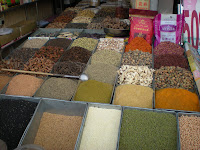
 n. Different staff; different rules.
I wandered through the alleys of Old Town for several hours. At one point a child was playing with a yo-yo. I took her picture, and gave her a thumbs-up for her skills. At her suddenly dismayed look, I remembered that thumbs up has an entirely different meaning in China than it does in Arabic countries. And in Uighur settllements? Who knows...
The train back (from one in the afternoon until one-thirty in the morning) was long ride. But my seat-mate spoke enough English for a 12-hour conversation, and the journey left my new John  Irving book undented. For the last half hour before arriving in Korla I did some magic tricks, which entertained about half of the car crowding around my seat.
 Irving book undented. For the last half hour before arriving in Korla I did some magic tricks, which entertained about half of the car crowding around my seat.
Arriving at Korla I told the taxi the name of my compound, and hooray he understood. I was prepared to say KFC (and even draw a picture of the Colonel), knowing that that he would have to drive past my home enroute to the chicken franchise.
It was an exotic trip. Just what I wanted. And even if I have been too lazy to properly describe its subtleties, maybe the picures will afford you a glimpse.


Friday, September 26, 2008
Chinese railroad worker: But what will you do?
Kwai Chang Caine: Work. Wander. Rest when I can
-from the television series, 'Kung Fu'
Jules: That's what I've been sitting here contemplating. First, I'm gonna deliver this case to Marcellus. Then, basically, I'm gonna walk the earth.
Vincent: What do you mean, walk the earth?
Jules: You know, like Caine in "Kung Fu." Just walk from town to town, meet people, get in adventures.
Vincent: How long do you intend to walk the earth?
Jules: Until God puts me where he wants me to be.
Vincent: What if he never does?
Jules: If it takes forever, I'll wait forever.
Vincent: So you decided to be a bum?
Jules: I'll just be Jules, VIncent. No more, no less.
-from the movie, 'Pulp Fiction'
Kwai Chang Caine: Work. Wander. Rest when I can
-from the television series, 'Kung Fu'
Jules: That's what I've been sitting here contemplating. First, I'm gonna deliver this case to Marcellus. Then, basically, I'm gonna walk the earth.
Vincent: What do you mean, walk the earth?
Jules: You know, like Caine in "Kung Fu." Just walk from town to town, meet people, get in adventures.
Vincent: How long do you intend to walk the earth?
Jules: Until God puts me where he wants me to be.
Vincent: What if he never does?
Jules: If it takes forever, I'll wait forever.
Vincent: So you decided to be a bum?
Jules: I'll just be Jules, VIncent. No more, no less.
-from the movie, 'Pulp Fiction'
Food and Festivals
I like rice. Rice is great if you're hungry and want 2000 of something. -Mitch Hedberg
I have been in Korla for one month. My first English lesson will take place next week, so for the last 30 days I have wandered through town, for all intents and purposes, as a deaf-mute.
This has its advantages. Be honest now: In this last month of the Presidential campaign, haven't you secretly wished you didn't understand English? Lucky George!
Still, the inability to verbally communicate does pose some logistical hurdles. Food comes to mind, for example, and the times when the food in my mind has failed to materialize as food in my stomach.
The compound I live in has a number of restaurants, and several of them are buffets. This is eating at its easiest, strolling down the line and selecting whatever looks appealing. There is always rice and always soup. A variety of vegetable dishes, some with meat and some without. Usually noodles, often bread, and always fruit. It's a piece of cake (without the cake).
Ah, but sometimes the meat misleads me. More than once I have bit into flesh, thinking it was something else, and found myself chewing liver. Those inscrutable chinese meats!
There is also a Uighur restaurant in the compound, and numerous more outside the gates. At first I kept pictures of the dishes I liked on my digital camera, to present the restaurant worker with a visual display of my desires. Now, I have a few Uighur words with which to order.
There are also many small eateries and sidewalk stands where I can employ the point-and-chew method.
I wrote earlier that this location is farther from an ocean than anywhere else. Maybe it's also the furthest city from a Taco Bell. There is however, a KFC, which has lured me in twice so far. There is no sign of McDonalds, nor of its icon, 'Uncle Ronald,' as he is known to the Chinese.
At times I even cook for myself, though admittedly it's been limited to stirfry and instant noodles.
The first time I went to a friend's home for dinner, I was served a big bowl of chicken's feet and chiles. Last week, dining with a couple of friends, they graciously put the fish head in my bowl...
Although I have been here only a short time, several holidays have already served me well. The first was Teacher's Day, when all the school staff had a half day off and were given 500 yuan in cash. In Western terms (certainly when compared with 700 billion dollars) 500 yuan is not much. But when an all-you-can-eat breakfast buffet costs two yuan, 500 of those guys go a long way. Teacher's Day was also recognized by numerous businesses in town, in the form of free gifts and discounts. And many students arrived bearing flowers and small gifts.
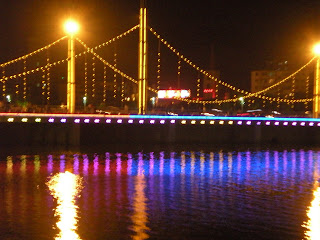
A few days later came the Mid-Autumn Festival. We were given a three-day weekend for this event, and a 300 yuan credit in the compound's stores. The park across the river from my apartment was brightly lit every night, along with the bridge, and hosted outdoor movies, vendors and cultural exhibits. The school also sponsored a one-day trip to the edge of the Taklamaken Desert.
And, coming up this week, is National Day (the anniversary of the People's Republic of China). Three days vacation for this event, and they are convening school on Saturday and Sunday so we will have seven consecutive days off. And, a cash bonus of 800 yuan. I'm planning to take those days and catch a sleeper train to Kashgar. It should be an experience.
May the bears and bulls of your market be kind, and may the bears and bulls of my market be non-existent (it's tricky enough to deal with the chickens and fish).
I have been in Korla for one month. My first English lesson will take place next week, so for the last 30 days I have wandered through town, for all intents and purposes, as a deaf-mute.

This has its advantages. Be honest now: In this last month of the Presidential campaign, haven't you secretly wished you didn't understand English? Lucky George!
Still, the inability to verbally communicate does pose some logistical hurdles. Food comes to mind, for example, and the times when the food in my mind has failed to materialize as food in my stomach.
The compound I live in has a number of restaurants, and several of them are buffets. This is eating at its easiest, strolling down the line and selecting whatever looks appealing. There is always rice and always soup. A variety of vegetable dishes, some with meat and some without. Usually noodles, often bread, and always fruit. It's a piece of cake (without the cake).
Ah, but sometimes the meat misleads me. More than once I have bit into flesh, thinking it was something else, and found myself chewing liver. Those inscrutable chinese meats!
There is also a Uighur restaurant in the compound, and numerous more outside the gates. At first I kept pictures of the dishes I liked on my digital camera, to present the restaurant worker with a visual display of my desires. Now, I have a few Uighur words with which to order.
There are also many small eateries and sidewalk stands where I can employ the point-and-chew method.
I wrote earlier that this location is farther from an ocean than anywhere else. Maybe it's also the furthest city from a Taco Bell. There is however, a KFC, which has lured me in twice so far. There is no sign of McDonalds, nor of its icon, 'Uncle Ronald,' as he is known to the Chinese.
At times I even cook for myself, though admittedly it's been limited to stirfry and instant noodles.
The first time I went to a friend's home for dinner, I was served a big bowl of chicken's feet and chiles. Last week, dining with a couple of friends, they graciously put the fish head in my bowl...

Although I have been here only a short time, several holidays have already served me well. The first was Teacher's Day, when all the school staff had a half day off and were given 500 yuan in cash. In Western terms (certainly when compared with 700 billion dollars) 500 yuan is not much. But when an all-you-can-eat breakfast buffet costs two yuan, 500 of those guys go a long way. Teacher's Day was also recognized by numerous businesses in town, in the form of free gifts and discounts. And many students arrived bearing flowers and small gifts.
A few days later came the Mid-Autumn Festival. We were given a three-day weekend for this event, and a 300 yuan credit in the compound's stores. The park across the river from my apartment was brightly lit every night, along with the bridge, and hosted outdoor movies, vendors and cultural exhibits. The school also sponsored a one-day trip to the edge of the Taklamaken Desert.

And, coming up this week, is National Day (the anniversary of the People's Republic of China). Three days vacation for this event, and they are convening school on Saturday and Sunday so we will have seven consecutive days off. And, a cash bonus of 800 yuan. I'm planning to take those days and catch a sleeper train to Kashgar. It should be an experience.

May the bears and bulls of your market be kind, and may the bears and bulls of my market be non-existent (it's tricky enough to deal with the chickens and fish).
Monday, September 8, 2008
A Walk Without Talk

Remember that river running between my compound and downtown? (psstt! If you don't, just scroll down).
Well, I went for a wander yesterday, and no bridge was required. I found out later that this is an annual phenomena; the water is stopped further upstream so that the muck and guck can be cleared away.
At any rate, as I was gingerly making my way across the channel, I noticed a number of people searching through (and pulling things out of) the sludge.
I was hesitant to look closer, in the event that their plunder resembled some mystery munchie from the compound restaurant. But it turned out to be some type of clam (or at least a clammish kind of shelled thing). Of course, they might have been pulling other things out as well..... Nope! I don't want to know.
I continued on my walk, through and beyond downtown. No specific destination; just window-shopping and people watching. When I reached my furthest point away from home (a couple of hours on foot), I realized that I had yet to use a public toilet in China. I also realized that I didn't know how to ask for one. Some things you just don't mime.
Oh, for the days of the John Muir Trail when the world was my toilet (in a good way).
The situation was becoming more than a tad uncomfortable, when I spied a sign with a graphic of a man and woman. Yes, relief!
Two lessons learned: One, until I learn to speak Mandarin, always carry my phrasebook. Two, always carry toilet paper. Like many Thai facilities, this was a squat toilet without paper. Unlike Thailand, there was no water spigot.
NOTE: If this blog entry is short, it's because my notes were used elsewhere. Nope, you don't want to know.
Well, I went for a wander yesterday, and no bridge was required. I found out later that this is an annual phenomena; the water is stopped further upstream so that the muck and guck can be cleared away.
At any rate, as I was gingerly making my way across the channel, I noticed a number of people searching through (and pulling things out of) the sludge.
I was hesitant to look closer, in the event that their plunder resembled some mystery munchie from the compound restaurant. But it turned out to be some type of clam (or at least a clammish kind of shelled thing). Of course, they might have been pulling other things out as well..... Nope! I don't want to know.
I continued on my walk, through and beyond downtown. No specific destination; just window-shopping and people watching. When I reached my furthest point away from home (a couple of hours on foot), I realized that I had yet to use a public toilet in China. I also realized that I didn't know how to ask for one. Some things you just don't mime.
Oh, for the days of the John Muir Trail when the world was my toilet (in a good way).
The situation was becoming more than a tad uncomfortable, when I spied a sign with a graphic of a man and woman. Yes, relief!
Two lessons learned: One, until I learn to speak Mandarin, always carry my phrasebook. Two, always carry toilet paper. Like many Thai facilities, this was a squat toilet without paper. Unlike Thailand, there was no water spigot.
NOTE: If this blog entry is short, it's because my notes were used elsewhere. Nope, you don't want to know.
Friday, September 5, 2008
Body odour (known also as the scent of the immortals) is a disgusting condition with an awful nauseating smell. It often affects social relationships and can delay life's major event: marriage. It disadvantages young men and women at job interviews or when they try to enlist, therefore inflicting much suffering and anguish. By using a new total treatment, we can instantly eradicate the odour with a rate of up to 97.53% success. For joy in life and future happiness, we welcome you to come and rid yourself of it....
-An advertisement, from the novel 'Soul Mountain,' by Gao Xingjian
-An advertisement, from the novel 'Soul Mountain,' by Gao Xingjian
Region, City, Town


Downtown (from my compound)
The bridge to downtown
A park in my compound
This introduction to the area will be brief, for two reasons. One, my knowledge of this area does not extend pass brevity. And two, if you're actually interested in more detail, you can always google it (which is what I'm doing).
But first (because 20 minutes is 19 minutes too long to spend on photo captions) in case this final attempt is equally unsuccessful: The pictures above (hopefully above) are: 1. A view of downtown from my compound, 2. the bridge to downtown, and 3. a park close to my apartment.
So, briefly then:
The Xinjiang Autonomous Region is in the northwest of the People's Republic of China. It's huge. In land mass, it accounts for one-sixth of China. It borders Tibet, Mongolia, Russia, Kazakhstan, Kyrgzstan, Afghanistan, Pakistan and India. Maybe more (countries are changing quicker than maps these days).
Xinjiang has the dubious distinction of boasting the farthest spot in the world from an ocean. It also has the second largest desert in the world, the Taklamakan, the fringes of which are not too far from my city. I forsee a sand-blown camel ride in my future.
The region is home to a large number of minorities (non-Han Chinese), which include Uygur, Kazak, Hui, Mongolian, Kirgiz, Tajik, Tatar, Uzbek, Daur, and other nationalities. There has been unrest among the minority groups, but I haven't been here long enough to assess the issues or to know how deep the unrest is.
Korla is the name of the city I live in. For thousands of years it has existed as a community along the famed Silk Road trade route. Officially though, it became a county in 1940, a prefecture in 1954, a part of the Bayin Guoleng Mongolia Autonomous prefecture in 1960, and was approved as a city in 1979.
The population, depending on what source you quote, is between 300,000 and 400,000. This is small by Chinese city standards, but relatively large for this area. Abundant farming land has always made the area a settlement, and the discovery of oil in the Taklamakan Desert has significantly increased the population (and Beijing's interest).
The city is roughly half Han Chinese, and half minorities (primarily Uygur).
Korla is known for its 'fragrant pears.' Every city in China seems to be known for something .... Don't sneer, you out there in the Land of Famous Potatoes.
I live inside a compound, which is basically a city within a city. There are approximately 5,000 inhabitants who work for the Tarim Petroleum Country (which oversees the school I work for). The school is in the compound, as are banks, restaurants, stores, police stations, parks, playgrounds and other things I haven't discovered yet.
A river runs through Korla, and it creates a border between my compound and the downtown area. Still, it's only a 10 minute walk to the bridge, and another 5 minutes into downtown.
In another direction, it's a ten-minute walk to a Uygur community with shops, restaurants and outdoor stalls. If I want to buy chicken (let's say for an innocuous, gentle stir fry), I am required to point to the live bird I desire and they will kill, chop and package it for me.
Where's the beef?
My apartment is a nice set-up; bedroom, kitchen, livingroom, bathroom and computer room. It came furnished, including a washing machine, television and computer. For complimentary housing, I can't complain.
Speaking of, when I was staying at a hotel in Urumxi, the towels were labeled 'uncomplimentary' (which I assumed refered to their possesion as opposed to their use).
Tuesday, August 26, 2008
Monday, August 25, 2008
The Beginning (again)


Declaration
*Please don't worry if a fire is occurring. We hotel have owned superior scatting facilities to ansure you transmitted safely.
*Please follow the direction route to the corridor and there safeguards will take you out to the security belts.
*Point profess your excellency seat.
-sign on my hotel room door in Urumxi
Now, I'm a guy who is amused by signs like 'SLOW CHILDREN PLAYING,' so I envision countless hours of future entertainment. Of course, if I ever need to follow any of these instructions, my enjoyment could be short-lived.
I accepted this teaching position while I was still in Thailand, and I chose this one in particular for several reasons. One, it did not begin until late August, allowing me to spend a few months back in the States. Two, I was intrigued by the region I'd be living in (more on this in future blogs). And three, they offered a one-semester contract. Since this is my first exposure to teaching and living in China, I was reluctant to commit for a full year. Better, I thought, to play it as it comes.
My flight from L.A. was direct to Beijing, and then I had a few hours until my flight to Urumxi, the capital of Xinjiang. I was met in Urumxi by Alena, the school official that I had arranged my employment with. We went from airport to a very plush hotel (owned by the same company I would be working for in Korla).
I crashed for a bit, and then met Alena for a delicious dinner in the hotel. Afterwards, I watched the Olympics for awhile before calling it a day. Or a night. Or whatever time my jet-lagged body thought it was.
The Olympics ran for another five days after my arrival, and the advantage of watching it in China was that it was covered by a variety of channels. This meant that I had a choice as to which event I was watching (and could view women's gymnastics instead of the men's marathon).
The second day in Urumxi we proceeded to the hospital, where I had an ecg, ultrasound, x-ray, blood and urine test....the whole works. I think the body hair on my chest was an unusual phenomena, and it was quite a process to make the suction cups adhere.
At any rate, we were told to return the following afternoon for the results and for my health document. This gave us the day to visit the cultural museum and Uigher bazzar, and to endulge in a couple more gastronomical experiences. Alena has proved to be a friendly and gracious host, with very good English.
The next day, we returned to the hospital, where it was pronounced that I had no abnormalities (if only they knew), and at 8 pm we caught a 12-hour train ride to the city of Korla. Which is where I am now.
The last few days were spent settling into my apartment, and getting to know the area a little. Not much English spoken here, and I've taken digital pictures of the popular dishes. This way, when I go into a restaurant, I can show them what I want on the screen of my camera (thanks, Linda).
So language will be one of the first orders of business, at least enough for restaurants and the marketplaces.
This morning I will teach a 'trial lesson,' something that every teacher (both Chinese and foreign) does before starting actual classes. I will be giving this lesson to 3rd graders, and the topic is 'feelings' (don't be alarmed; I won't be singing the song).
In the near future, I plan to write a little about this region, this city, and the compound in which I am living. But for now, off to share the meaning of happy, sad, angry, etc. Wish me luck!
Saturday, August 23, 2008


Subscribe to:
Posts (Atom)

